“Give, and it will be given to you. A full measure, pressed down, shaken together and running over, will be poured into your lap. For with the measure you use, it will be measured to you.” – Luke 6:38
The arithmetic of the Kingdom of God seems to defy nearly everything we have been taught about the world in which we live.
We measure our lives by what we possess, what we accomplish, and what we manage to preserve for ourselves. We count our earnings, ration our time, and carefully consider what we can afford to give away. From an early age, we learn that the more we surrender, the less we have remaining.
It is a perfectly reasonable conclusion in the economy of man.
Yet Christ introduces us to an entirely different economy, one in which giving does not necessarily lead to emptiness, and withholding does not necessarily lead to abundance. In the Divine Economy, the mathematics of heaven rarely resembles the mathematics of earth.
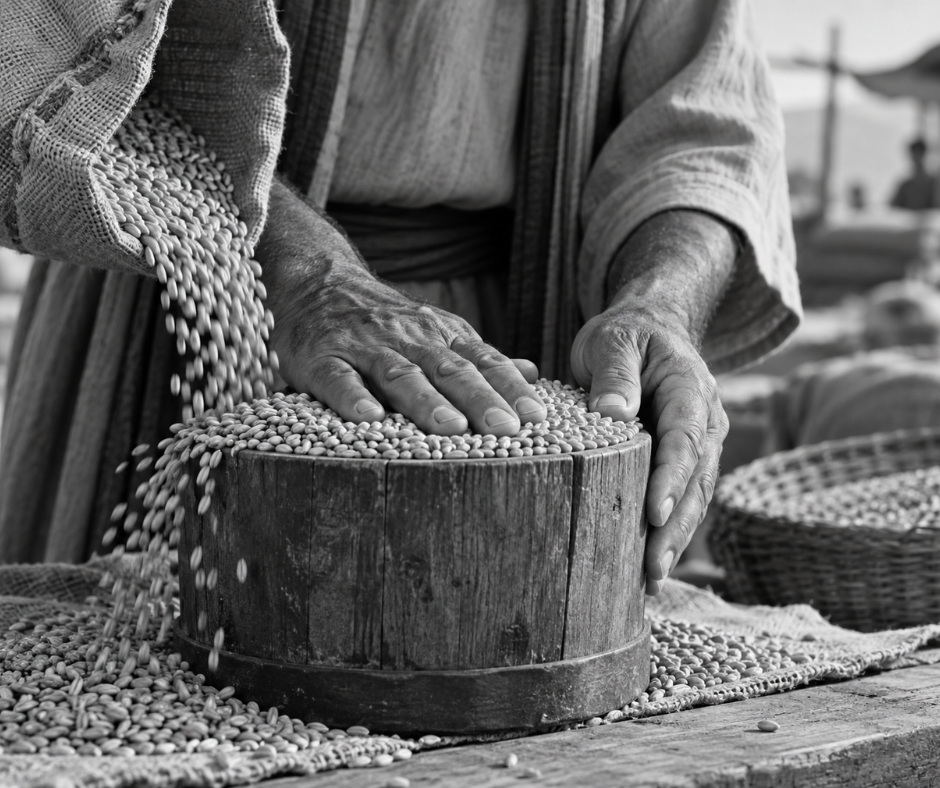
In Luke 6:38, Jesus offers a picture of generosity: a full measure, pressed down, shaken together, and running over.
Imagine the marketplace of the ancient world, where grain was measured into a container for purchase. A dishonest merchant might fill the vessel loosely, leaving pockets of air between the grains, providing the appearance of fullness without its substance. A generous merchant, however, would press the grain down, shake the vessel to eliminate the empty spaces, and continue pouring until the contents overflowed. The customer would receive not merely what was expected, but an abundance beyond the measure itself.
Jesus uses this familiar image to reveal something extraordinary about the generosity He desires to cultivate within us.
Yet we must be careful not to misunderstand His words. The Divine Economy is not a heavenly investment scheme in which we offer kindness, money, or service in anticipation of receiving something greater in return. God is not a merchant with whom we negotiate favorable terms, nor is generosity a currency by which we purchase His blessing. If our giving is motivated entirely by what we hope to receive, we have merely disguised self-interest as charity. The greater lesson is found in the surrounding teachings of Christ, where He calls us to love our enemies, extend mercy, and forgive freely. His invitation is not simply to give more, but to become the sort of person whose heart is no longer governed by the fear of having less.
And perhaps that fear is the very thing that keeps so many of us living with half-empty measures.
The world encourages us to accumulate possessions in hopes of finding security, accomplishments in hopes of finding significance, and experiences in hopes of finding fulfillment. We protect our schedules, our resources, and even our affections. We hesitate to forgive because we fear it will diminish the seriousness of the offense. We withhold kindness because we wonder whether it will be appreciated. We resist generosity because we cannot see how the numbers will work in our favor. And so, with great determination, we spend our lives guarding the contents of a vessel that was never intended to remain closed.
This is not to suggest that our earthly resources are infinite, or that wisdom has no place in generosity. Scripture speaks often of stewardship, discernment, and responsibility. The Divine Economy does not require us to neglect our families, exhaust our bodies, or surrender every boundary in the name of selflessness. Rather, it challenges the motives beneath our decisions. Are we exercising wisdom, or are we being governed by fear? Are we preserving what has been entrusted to us for a worthy purpose, or merely protecting our own comfort? There is a profound difference between careful stewardship and a scarcity of spirit.
The abundance Jesus describes is deliberate in nature. The measure is not casually filled – it is pressed down. It is shaken together. It is filled again until it runs over. There is intention in every movement. Perhaps this also offers us a picture of the ways God works within the human heart. We often ask Him to fill us while resisting the very circumstances through which He might make room for something greater. We desire patience without inconvenience, compassion without suffering, forgiveness without injury, and faith without uncertainty. Yet these virtues are seldom formed in the absence of the experiences that require them. Sometimes the pressing and shaking of life reveal the empty spaces within us, places where pride, fear, resentment, or self-reliance have prevented us from receiving what God desires to cultivate.
We must not assume that every hardship is a deliberate act of God designed to produce a blessing. But we can trust that no hardship is beyond His ability to redeem. A heart that has known sorrow may become unusually tender toward the suffering of others. A person who has experienced forgiveness may discover a greater capacity to extend mercy. Someone who has walked through a season of need may become generous when given the opportunity to provide for another. What once appeared to be a season of depletion may become a place from which grace flows.
We often discover the abundance of something only after we begin to share it. Love does not behave like a loaf of bread that becomes smaller with each portion distributed. The love of a parent does not diminish with the arrival of another child. Gratitude, when expressed, often grows rather than decreases. And forgiveness, though sometimes painfully difficult, may release the one who offers it from a burden that withholding it could never resolve.
These are glimpses of a Kingdom in which the richest possessions cannot be stored in a barn, deposited into an account, or measured by earthly standards.
How differently we might live if we began each morning not by asking what we needed to acquire, accomplish, or protect, but what we had been given to share? Perhaps we would become more generous with our encouragement, more patient with the weaknesses of others, more attentive to the lonely, and more willing to offer forgiveness before resentment takes root. Perhaps we would recognize that a full life is not necessarily one crowded with possessions, obligations, and achievements, but one overflowing with the things that reflect the heart of Christ.
For the measure of a life is not found merely in what it contains, but in what it pours out.
The world will continue to teach us to gather, to guard, and to count. But Jesus invites us into something wonderfully different: He calls us to open our hands, extend mercy, give without keeping score, and trust that the God who is the Source of all goodness is not impoverished by our generosity.
And perhaps, in the end, we will discover that the greatest abundance was never found in the measure we managed to keep for ourselves, but in the grace that flowed through us into the lives of others.
A good measure. Pressed down. Shaken together. Running over.
Not simply a promise of what we might receive, but a beautiful picture of how we are called to live.
Such is the wonder of the Divine Economy.