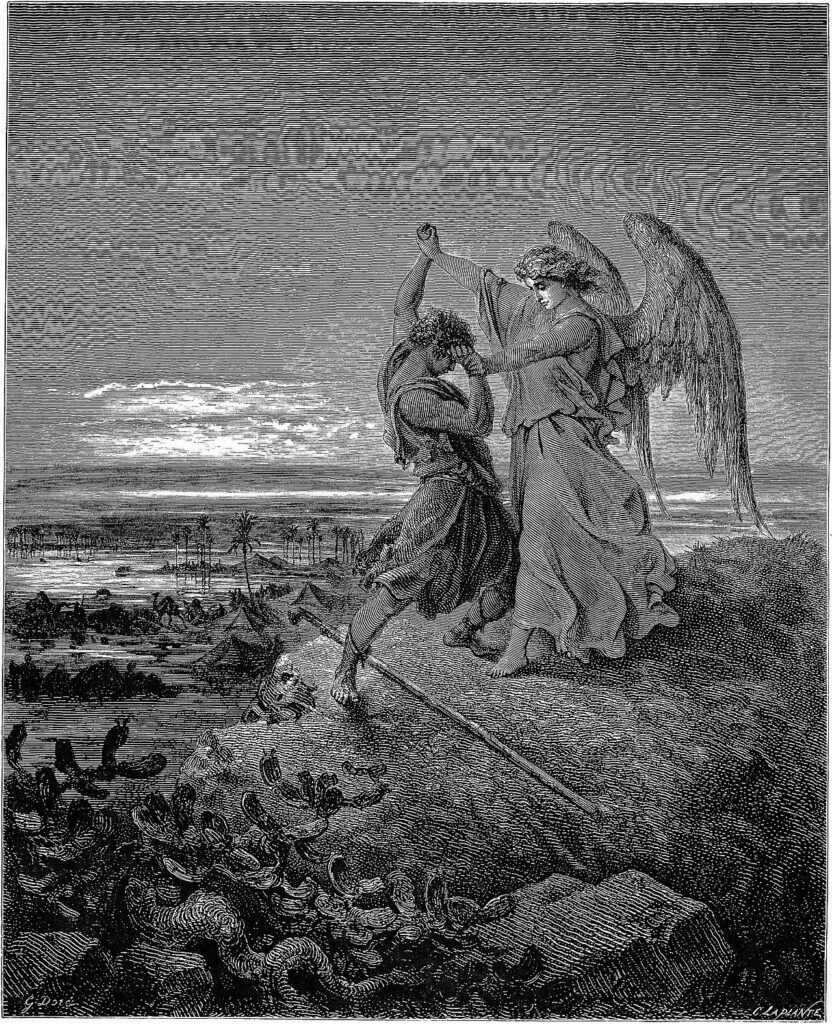
“For the Lord disciplines the one he loves, and chastises every son whom he receives.” — Hebrews 12:6
Humans tend to measure love by what we are given, what we are spared, and how smoothly the road rises before us. If one man seems to pass through life with money in his pocket, health in his body, opportunity at his doorstep, and scarcely a locked door before him, we are tempted to say that surely God has favored him. And when another seems forever acquainted with disappointment, loss, delay, and struggle, we quietly wonder what he has done wrong.
We have made comfort into evidence of blessing and hardship into evidence of abandonment. Yet Scripture repeatedly refuses to allow us such a simple equation.
Paul gives us one of the more difficult examples in Romans 9 when he reaches back to the story of Jacob and Esau. Before the twins were born, before either had done anything good or bad, God declared that His purposes would proceed through Jacob. Paul then quotes the prophet Malachi: “Jacob I loved, but Esau I hated.” These words can sound terribly harsh to modern ears because we instinctively hear “love” and “hate” primarily as emotions. Yet in this context, the language points us toward God’s choosing, covenant purpose, and divine appointment. Jacob was chosen for one purpose, Esau for another. And strangely enough, the life of the chosen man hardly looked like the easier one.
Jacob was not chosen because he was naturally noble. Quite the opposite. He was a schemer, a manipulator, a man accustomed to getting what he wanted through cleverness. He deceived his brother and his father. He fled from home. He spent years dealing with Laban, a man every bit as capable of manipulation as Jacob himself. Again and again, Jacob discovered that being chosen by God did not mean being protected from every difficulty. In many ways, it meant being confronted by the very things in himself that could not accompany him where God intended to take him.
Then came the night when Jacob wrestled with God.
By morning, Jacob had received both a blessing and a wound. His name was changed to Israel, but his hip was out of joint. He walked away from the encounter blessed, chosen – and limping. We might have expected divine favor to straighten his path. Instead, it altered his walk.
There is something revealing in that image. God did not merely give Jacob something to carry. He changed the way Jacob carried himself.
The man who had spent much of his life relying upon his own cleverness would now take every step with a physical reminder that strength has limits. Perhaps the limp that appeared to weaken him was, in another sense, one of God’s mercies toward him. Jacob could no longer move through the world exactly as he had before. His weakness became a continual invitation to dependence.
This is where our understanding of God’s love often collides with God’s purposes. We want love to mean that God removes the difficult thing. God may sometimes express His love by doing precisely that. But at other times, His love is revealed by what He allows to remain because He intends to produce something in us that comfort never could.
Hebrews tells us plainly that discipline belongs to sons and daughters who are loved. That turns much of our worldly reasoning upside down. We naturally assume that the person experiencing the least resistance must be the most favored. Scripture asks us to consider another possibility: sometimes resistance is evidence that God is shaping a life for something greater than ease.
This does not mean that every hardship is a punishment from God, nor should we look at another person’s suffering and presume to know what God is doing through it. Jesus Himself warned against such simplistic conclusions. But it does mean that difficulty cannot automatically be interpreted as divine rejection. A closed door does not necessarily mean God has forgotten you. A season of waiting does not necessarily mean He has withheld His goodness. And the wound you have begged Him to remove may not be proof that He loves you less.
We see only the road. God sees what the road is making of the traveler.
Perhaps that is why comparison is so dangerous. We look at someone else’s life and see the doors that opened for them, never knowing what God has appointed for them or what He has appointed for us. We see their abundance and our limitation. Their opportunity and our delay. Their apparent ease and our limp. Then we make the mistake of assuming that God’s affection can be measured by circumstances.
But Esau could walk without Jacob’s limp.
Jacob was the one who wrestled with God.
Jacob was the one who walked away wounded.
And Jacob was the one through whom God would build Israel.
There are times when God’s love looks less like being carried around the struggle and more like being transformed through it. The very thing we would remove from our story may become the thing that teaches us to lean upon Him. We ask God to make us strong, while He may be teaching us the far greater lesson of where our strength actually comes from.
Perhaps, then, we should be slower to envy the person whose road appears easier. We do not know their calling, and they do not know ours. God is not writing identical stories. Divine love cannot be measured by bank accounts, opportunities, promotions, health, possessions, or the absence of pain. The Christian faith does not promise that those whom God loves will never limp. Scripture gives us something far stranger and, ultimately, far more hopeful.
Sometimes the limp belongs to the one He has called closer.
And perhaps one of the great mysteries of faith is discovering that what we once regarded as evidence that God had withheld His favor was, in time, the very thing through which He taught us to depend upon Him. Jacob entered that night trusting his own strength. He left limping.
There are far worse ways to walk with God.