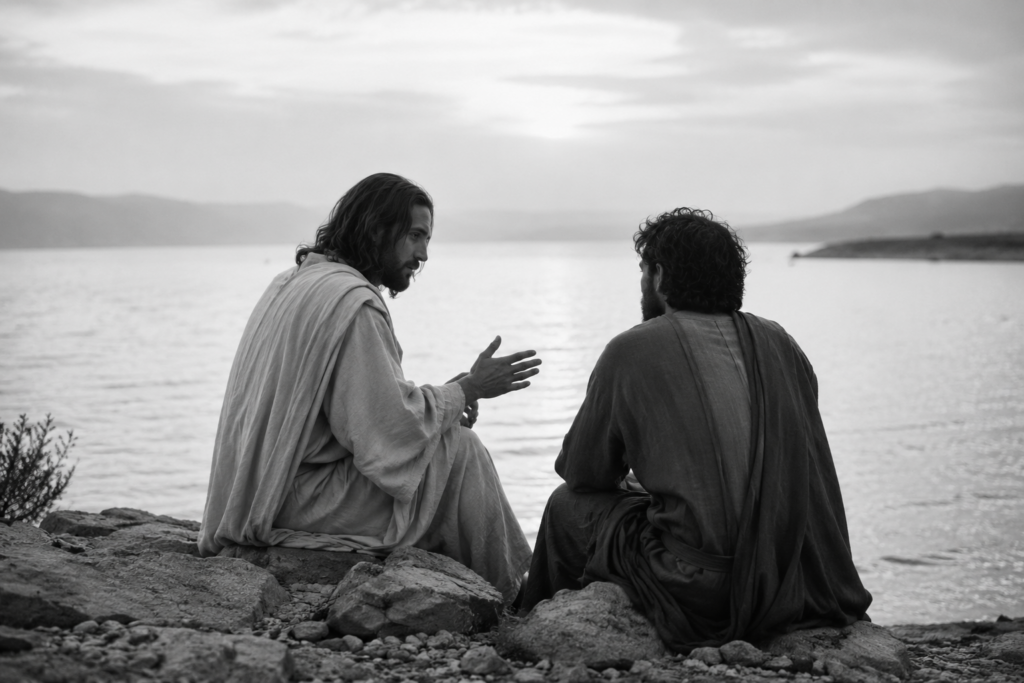
“But He turned and said to Peter, ‘Get behind Me, Satan! You are a hindrance to Me. For you are not setting your mind on the things of God, but on the things of man.'” – Matthew 16:23 (ESV)
We hear Christ say, “Get behind Me, Satan,” and immediately imagine that Peter has somehow become the enemy of God. Yet such a conclusion ignores both the man and the moment. Only verses earlier, Peter had confessed Jesus to be the Christ, the Son of the living God. Jesus Himself declared that such understanding had not arisen from Peter’s own wisdom, but had been revealed by the Father.
Peter had not suddenly transformed from disciple to devil.
What changed was not Peter’s identity, but Peter’s perspective.
Our Lord had begun revealing what lay ahead. Jerusalem. Rejection. Suffering. Death. The cross.
Peter, unable to reconcile such things with his understanding of the Messiah, could not bear it.
“Never, Lord.” One can almost hear the affection in those words. Peter was not motivated by malice. He was motivated by love. He wished to spare Christ from suffering.
But love, detached from the purposes of God, can become strangely dangerous.
There is a temptation among Christians to imagine that anything born of kindness must necessarily be from God. Scripture gives us no such assurance. Kindness may oppose God’s will just as easily as cruelty may. Compassion, if governed only by human instinct, will often seek to remove the very trials God intends to use.
The difficulty is that Heaven and earth do not evaluate suffering in quite the same way.
Man sees pain and assumes failure. God often sees pain and prepares redemption.
Man avoids sacrifice whenever possible. God accomplishes His greatest victories through it.
Peter’s words, though sincerely spoken, echoed another voice Christ had already heard.
In the wilderness, Satan had offered Him a kingdom without a cross. Throughout His ministry the temptation remained essentially unchanged: accomplish the mission by some easier road. Surely there must be another way.
Peter was not Satan.
He simply spoke the language Satan had always spoken.
This is why Jesus answers as He does. He is not condemning Peter’s heart. He is exposing the philosophy behind Peter’s words.
“You are not setting your mind on the things of God, but on the things of man.”
It is difficult to imagine a sentence more relevant to our own age.
Modern life trains us, almost unconsciously, to believe that the highest good is comfort. We possess machines that eliminate inconvenience, medicines that promise relief, devices that satisfy curiosity in moments, and endless opportunities to insulate ourselves from discomfort. There is much to be grateful for in these blessings. Yet every blessing carries the possibility of becoming a teacher, and comfort is an instructor that quietly repeats the same lesson until we no longer question it:
Avoid difficulty.
Protect yourself.
Choose the safer road.
Eventually we begin assuming that God must surely desire the same things.
When He calls us somewhere costly, we hesitate.
When obedience threatens our security, we question whether we heard Him correctly.
When faith requires surrender, we begin searching for an alternative that seems more reasonable.
It is remarkable how often we mistake prudence for faithfulness.
This is not to suggest that recklessness is a Christian virtue. Scripture never praises foolishness. The disciple is called to wisdom, humility, and discernment. We are commanded to seek counsel, to weigh our decisions carefully, and to test every spirit.
Yet there exists another danger altogether.
There are moments when what appears most reasonable is, in fact, merely the fear of losing control.
Fear is rarely honest enough to introduce itself by name.
It prefers to borrow the language of responsibility.
It speaks of security.
It speaks of practicality.
It speaks of common sense.
It even speaks with the voices of people who love us.
Indeed, this may be its most persuasive disguise.
There are few burdens heavier than disappointing those whose affection we value. A parent wishes to spare a child from hardship. A friend urges caution. A spouse worries about uncertainty. None of these desires are inherently wrong. Peter desired only to protect the One he loved.
Yet affection alone cannot determine truth.
The question has never been whether those around us love us.
The question is whether the counsel being offered is rooted in the Kingdom of God or merely in the instincts of man.
Every Christian who earnestly seeks to obey Christ will eventually discover that these are not always the same thing.
There will come a moment when the path of obedience appears unnecessarily costly, almost unreasonable. The world will offer alternatives that seem wiser, safer, and infinitely more sensible. Even fellow believers, with the best of intentions, may gently encourage us toward a road that asks less of us.
At such moments we should remember that the cross has never appeared reasonable from the perspective of the world.
If Christianity were merely a philosophy for achieving comfort, Calvary would never have happened.
The Son of God did not redeem the world by avoiding suffering but by walking directly into it in perfect obedience to the Father.
The Christian, then, is not called to admire that obedience from a distance. He is called to participate in it.
This does not mean we seek suffering for its own sake. It means we cease treating comfort as the measure of God’s favor.
Surrender is the one thing our age finds most difficult to understand. Perhaps that is why Jesus’ rebuke still startles us.
Not because it was severe. But because it reveals how easily even sincere disciples can begin thinking more like the world than like the Kingdom.
There will always be voices urging us to avoid the cross in whatever form it appears before us. Some will come from our culture. Some will rise from our own hearts. Some will come from people whose love is genuine.
But Christ never asked His followers to choose the safest road.
He asked them to follow Him.
For the disciple who has decided that Christ is worthy of complete obedience has already surrendered the only thing the world can truly threaten.
Such a man is not fearless because he believes nothing difficult will happen.
He is fearless because he has come to believe that nothing, however difficult, can separate him from the will of God, and that there is no safer place in all creation than to be found there.