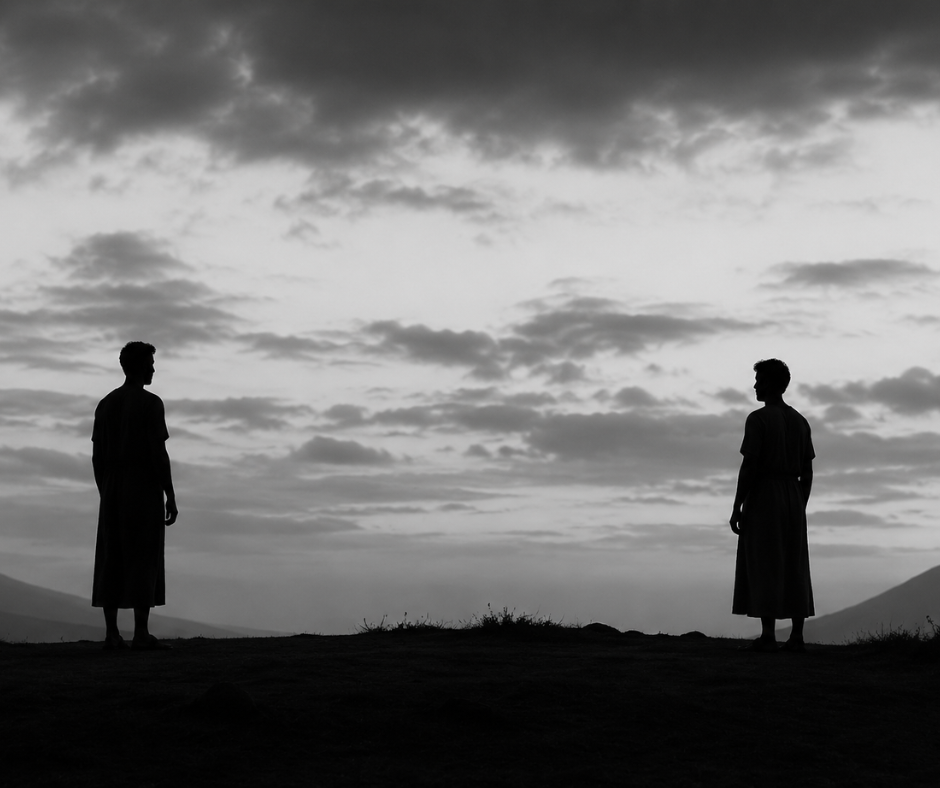
“If you do well, will you not be accepted? And if you do not do well, sin is crouching at the door. Its desire is for you, but you must rule over it.” — Genesis 4:7
There are passages in Scripture that command our attention, and there are others we quietly pass over. The story of Cain and Abel occupies only a handful of verses in Genesis. We tend to remember it simply as the account of the first murder, then move on.
Yet, as is so often the case with Scripture, what appears to be a small story contains immeasurable depth. Hidden within these few verses is a portrait of the human heart that feels as current today as it did in the first family ever created. It is a story of worship and resentment, obedience and pride, mercy and judgment.
More than anything, it is a story about the choices we make long before anyone else sees them.
The story begins not with murder, but with worship. Both brothers brought an offering before God. Outwardly, they each appeared to be doing the same thing. Both participated in the ritual. Both approached the altar. Yet God regarded Abel’s offering and not Cain’s.
At first glance, this may seem unsettling. Why would God accept one and reject the other?
Scripture gives us the answer. “By faith Abel offered to God a more acceptable sacrifice than Cain” (Hebrews 11:4). The difference was never merely the gift itself. It was the heart behind it.
Abel’s offering was an expression of trust. He brought the first and the best because he believed God was worthy of both. Cain, on the other hand, appears to have simply fulfilled an obligation. He offered something, but not himself.
This distinction echoes throughout all of Scripture. God has never been interested in religious performance detached from genuine devotion. He desires obedience more than ceremony, surrender more than routine, hearts more than habits.
It is an uncomfortable truth because many of us recognize seasons of our own lives in Cain. We still attend church. We still pray before meals. We still serve when asked. Yet somewhere along the way, our worship becomes an afterthought rather than an overflow. We perform the motions while our hearts quietly drift elsewhere.
God sees what no one else can.
Human beings often misunderstand one another. Human parents, despite loving their children deeply, are imperfect. They may unintentionally praise one child more than another, show greater patience toward one personality than the next, or fail to recognize the quiet struggles hidden beneath the surface. Some children grow up carrying wounds from favoritism or constant comparison. Others wrestle with resentment that slowly settles into the corners of the heart. Scripture itself warns parents not to provoke their children to anger.
Those wounds are real.
But Genesis is not primarily telling us about imperfect parents.
It is introducing us to a perfect Father.
Unlike human beings, God cannot be deceived by appearances. He does not judge according to personality, charisma, talent, or outward success. He is neither biased nor mistaken. He sees what no parent, teacher, spouse, pastor, or friend can fully see. He looks directly into the heart.
This is what makes Cain’s response so tragically familiar.
When God accepted Abel’s offering, Cain did not stop to examine himself.
He examined his brother.
How often do we do the very same thing?
Someone else’s marriage appears stronger.
Someone else’s ministry flourishes.
Someone else’s business grows.
Someone else’s prayers seem answered while ours feel unanswered.
Rather than asking, “Lord, what are You teaching me?” we quietly begin asking, “Why them?“
Comparison is remarkably deceptive. It convinces us that someone else’s blessing is the cause of our disappointment. In reality, the other person often serves only as a mirror reflecting something unsettled within ourselves.
Cain’s greatest problem was never Abel.
Abel simply became the visible reminder of Cain’s invisible heart.
Before Cain ever acted upon his anger, God did something astonishing.
He warned him.
“If you do well, will you not be accepted? And if you do not do well, sin is crouching at the door. Its desire is for you, but you must rule over it.“
Sin is not described as charging toward Cain with overwhelming force. It is pictured as a predator lying quietly outside the door. Patient. Waiting. Watching for the moment the door is left unguarded.
God did not tell Cain that anger itself was sinful.
He warned him about where unchecked anger leads.
This distinction matters.
We will all experience jealousy.
We will all experience disappointment.
We will all wrestle with rejection, loneliness, frustration, and grief.
These emotions are not the enemy.
They become dangerous when we invite them to remain long enough to become masters instead of messengers.
Feelings make terrible rulers.
God’s warning to Cain reminds us that sin rarely begins with an action. It begins with a thought entertained. A wound rehearsed. A resentment protected. A comparison repeated until bitterness quietly feels justified.
Long before murder entered Cain’s hands, it had taken root in his heart.
This is why Scripture repeatedly turns our attention inward instead of outward.
Jesus tells us first to remove the log from our own eye.
Paul encourages believers to examine themselves.
James warns against envy and selfish ambition because where they exist, disorder soon follows.
Again and again, God calls us away from comparing our lives with others and toward examining the condition of our own souls.
Cain ignored the warning.
His anger matured into envy.
His envy matured into violence.
His violence matured into separation.
When Cain killed Abel, he believed he was destroying his brother’s future.
Instead, he surrendered his own.
He lost his home.
He lost the familiarity of family.
He became a wanderer.
The life he had always known disappeared beneath the weight of one decision that had been forming long before anyone else saw it.
Sin always promises satisfaction.
It almost always leaves us homeless.
Perhaps that is one of the greatest tragedies of unchecked jealousy. It not only wounds the one against whom it is directed; it slowly dismantles the life of the one who harbors it. Relationships fracture. Trust disappears. Peace becomes elusive. Even when forgiveness is offered, consequences often remain.
Cain could never restore what had been lost.
Neither could Abel.
Only God could continue writing the story from there.
The mercy of this passage is not found only after the fall.
It is found before it.
Before judgment came, God spoke.
Before consequences came, God warned.
Before death entered the field, mercy stood at the door.
The same God who spoke to Cain still speaks to us today.
Every day something crouches outside the doors of our hearts.
Pride.
Bitterness.
Envy.
Resentment.
Self-righteousness.
Fear.
Each waits patiently for permission to enter.
The question is not whether temptation will come.
The question is whether we will recognize it while it is still outside the door.
The story of Cain and Abel is not merely about two brothers.
It is about every one of us.
Every day we choose whether our worship will be genuine or routine.
Whether another person’s blessing will inspire gratitude or comparison.
Whether we will allow painful emotions to lead us toward God or away from Him.
Whether we will heed His warning before sin gives birth to consequences that cannot be undone.
The remarkable grace of Genesis 4 is that God still warns before He judges.
He still calls us to repentance before destruction.
He still invites us to lay our hearts before Him instead of measuring our lives against everyone else’s.
For the greatest battle we will ever fight is rarely with another person.
It is with whatever has been quietly crouching at the door of our own hearts.