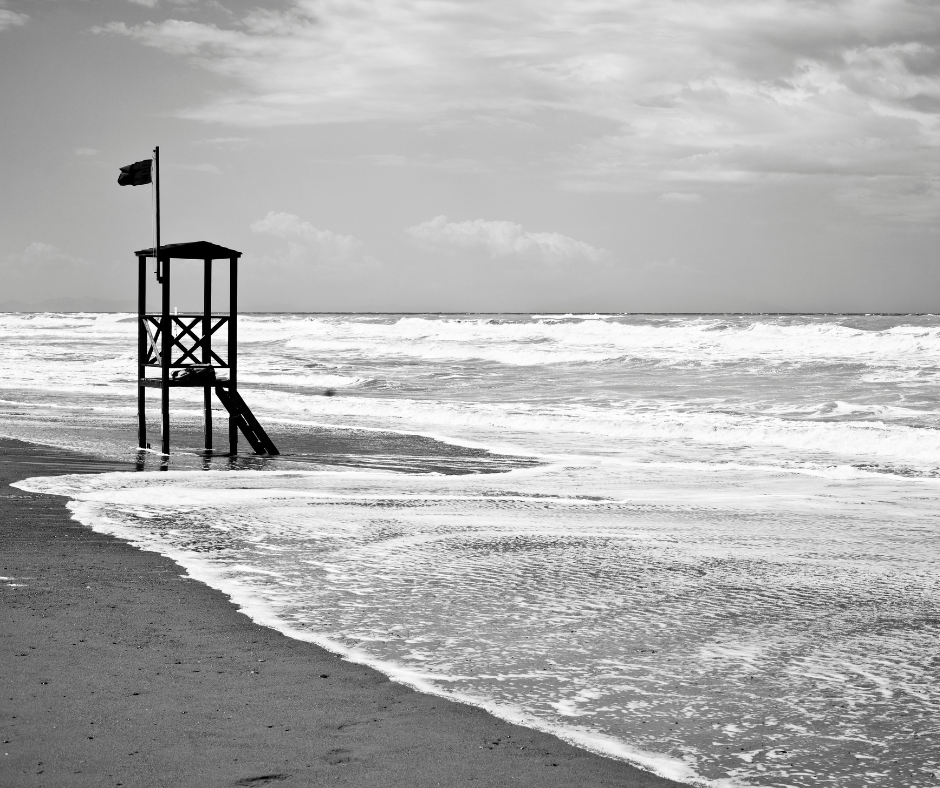
Recently, a 16-year-old lifeguard was honored by the White House for helping rescue a 10-year-old boy from dangerous surf at Seabright State Beach in Santa Cruz, California. The waves were reportedly reaching nearly ten feet. When the lifeguard saw the child struggling, he did not have time to stop and consider what ought to be done. He ran. He positioned himself in the deep water. He relied upon the rescue techniques he had practiced again and again.
It was certainly an act of courage. But it was also an act of preparation.
When the moment came, his training became instinct.
There is something deeply spiritual about that.
We often imagine great faith as something that suddenly appears when the great trial arrives. We picture courage descending upon us at precisely the moment we need it, as though heroes are created on the battlefield. Scripture, however, tells a different story.
Long before David was King David, he was a shepherd boy in Bethlehem.
He was the youngest son of Jesse, tending sheep while his older brothers went off to war. One day he would become Israel’s king, the psalmist whose words would teach generations how to pray, and the father of Solomon. But when David first stepped into one of Scripture’s most famous battles, he was likely still very young.
Across the valley stood Goliath, the Philistine champion who had terrified an entire army. David was not impressed. Not because Goliath wasn’t frightening, but because David measured the giant against something greater than himself.
“The battle is the Lord’s.” – 1 Samuel 17:47
But David’s trust in God was never an excuse for neglecting preparation.
David had fought before. In the lonely fields where no crowds applauded him, he had defended his father’s sheep from lions and bears. The sling in his hand was not a prop chosen for a dramatic biblical moment. It was familiar. He had used it before. He had practiced with it. His hands knew what to do because they had done it countless times when no one was watching.
Even David’s refusal of Saul’s armor reveals something important. Saul offered him the equipment of a soldier: armor, sword, protection. On the surface, these things appeared far more advantageous than a shepherd’s sling. But David had not trained in them.
So he took them off.
David refused to enter his battle pretending to be someone God had not trained him to be. Instead, he stepped onto the battlefield carrying what God had already taught him to use.
That may be one of the most overlooked lessons in the story of David and Goliath. We remember the giant. We remember the stone. We remember the miraculous victory.
But heaven had been preparing David long before Goliath ever knew his name.
The lion mattered. The bear mattered. The lonely afternoons mattered. The countless stones thrown when there was no audience mattered.
His public victory rested upon years of private faithfulness.
And perhaps ours will too.
We tend to ask God to prepare us once the giant appears. But perhaps much of God’s preparation has already been happening in the ordinary days we are tempted to dismiss. Every morning we open Scripture when there is no crisis. Every prayer whispered when life is relatively calm. Every temptation resisted when no one would know otherwise.
Every act of obedience, discipline, integrity, forgiveness, and perseverance is training the soul.
We are learning where to reach when trouble comes.
Because when the waves are ten feet high, there may not be time to learn how to swim.
When Goliath is standing before us, there may not be time to learn how to use the sling.
This is the power of prepared faith.
Prepared faith does not presume that preparation guarantees safety. Nor does it imagine that skill somehow replaces dependence upon God. It is quite the opposite. Prepared faith recognizes that the God who performs miracles is also the God who teaches shepherd boys to throw stones and lifeguards how to enter dangerous water.
God can certainly accomplish the impossible without our help. But throughout Scripture, He so often chooses to work through people who have been faithful with what He placed in their hands.
Moses had a staff. David had a sling. The disciples had a few loaves and fish.
And we have prayer, Scripture, experience, discipline, wisdom, and skills quietly developed through years we did not realize were preparing us for anything at all.
Then the giant appears. And suddenly we understand why God taught us to use the sling.
Our battles may not involve Philistine warriors or crashing Pacific waves. They may look like grief, uncertainty, temptation, financial difficulty, a frightening diagnosis, a broken relationship, or a moment when someone desperately needs us to be brave.
In those moments, we will reach instinctively for what we have practiced faithfully.
That is why today’s ordinary obedience matters. Read the Scripture now. Pray now. Practice courage now. Choose integrity now. Learn the skill now. Be faithful in the field now.
We do not know which quiet disciplines God may one day use in a very loud battle.
Faith is trusting that the battle belongs to the Lord.
Prepared faith is having the stone ready when it does.